
In Hinduism or Tantra, Ganesha Sadhana practices can be used for removing obstacles—inner, not just outer—focusing attention, calming the mind, and starting a more serious spiritual evolution. “Why Is Ganesha Worshipped First?”Ganesha is typically called upon first because he represents the removal of barriers, as he is often known for opening new paths.
Tantra can be expressed through ritual activities that have a wide range of complexities, from simpler forms based in devotion to those that culminate in ceremonies involving highly advanced techniques that require a guru to assist.
Stories of Lord Ganesha
1. Birth of Ganesha
Mata Jagatjanani Parvati created Ganesha using sandalwood from her body so that he could guard her during her bath. Shiva came home and did not recognize Ganesha, who was stopping him at the front door, and he became angry. Therefore, he cut Ganesha’s head off. Parvati was upset by this and asked Shiva to replace Ganesha’s head. Shiva said he would do this and put an elephant head on Ganesha. This is how Ganesha was created and how he became the beloved god that he is today.
2. Why Ganesha is Worshipped First
The deities of the divine gathering were discussing who among them would be the first to receive worship. To settle this dispute, Shiva suggested they hold a race. Whoever completed a circumnavigation of the universe first would get the first worship. Kartikeya rode his peacock and flew off to go to each of the worlds, but Ganesha only went around his parents, Shiva and Parvati, telling them that they represented his whole universe. This made them very happy, so they blessed Ganesha to be worshiped before everyone else at all beginning ceremonies.
3. The Broken Tusk
According to the Mahabharata, Ganesha has a broken tusk. Sage Vyasa needed someone to write down the Mahabharata while he recited and dictated the information. Ganesha agreed to do the writing for Vyasa. However, when Ganesha broke the pen he was using, he broke off one of his tusks and continued to write without stopping. Ganesha’s breaking his tusk was a demonstration of determination in helping to create the Mahabharata, or document a huge epic goal.
4. The Mango of Knowledge
Shiva and Parvati received a heavenly mango from Sage Narada, who instructed them not to divide it up. Subsequently, Shiva arranged a competition between his two sons, Kartikeya and Ganesha, to determine who would receive the mango. The competition consisted of Kartikeya travelling three times around the world on his mount, while Ganesha slowly walked around Shiva and Parvati three times, declaring them his entire universe. Ganesha was awarded the mango in recognition of his wisdom over the speed of the competitors.
5. Ganesha and Kubera
The god of wealth named Kubera once hosted a lavish banquet for Shiva and Parvati, showcasing his wealth. Rather than attending, they sent their son, the young Ganesha, in their stead. Ganesha ended up consuming whole foods prepared for the festivities, including everything in Kubera’s palace. This frightened Kubera, so he ran to Shiva for assistance. In response, Shiva directed Kubera to humbly offer Ganesha a simple bowl of white rice. Upon doing so, Ganesha was satisfied with the humble offering, demonstrating that devotion and humility are of greater importance than pride and material wealth.
The symbolic meaning of Ganesh in tantra
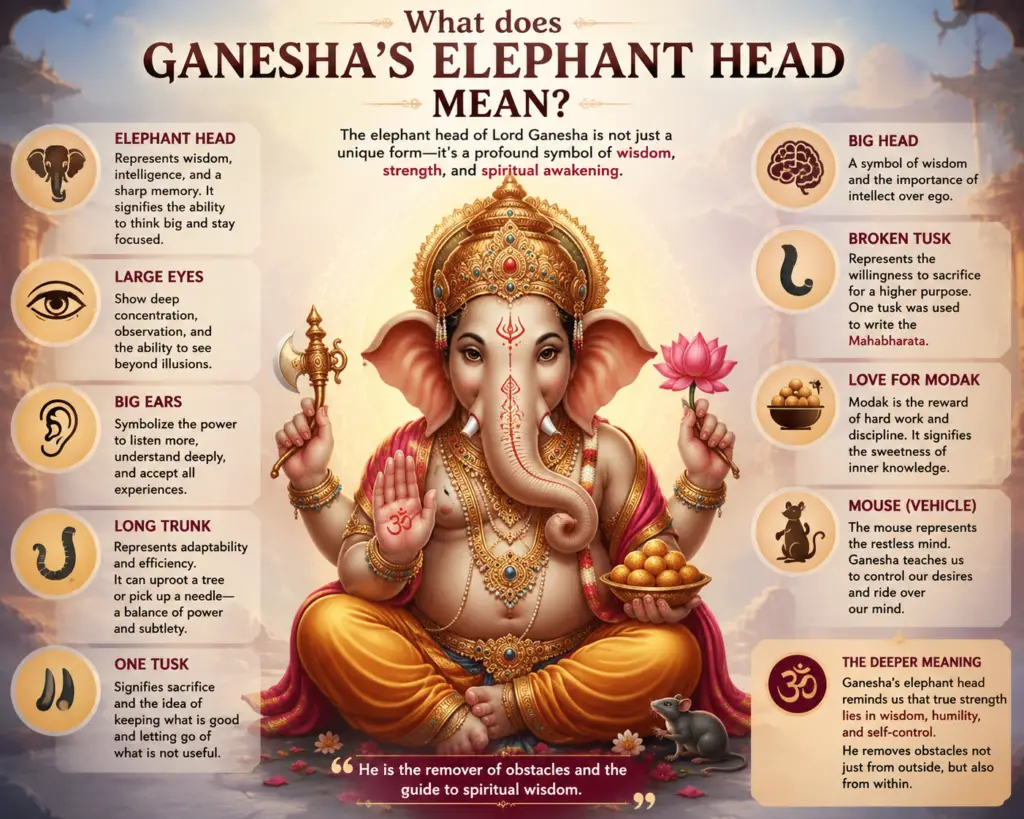
In Tantra, Ganesha is not viewed only as an external god to worship. He is also understood as a symbolic map of consciousness, stability, and mastery over inner obstacles. Different tantric lineages interpret the symbols differently, but several themes appear often.
- Elephant Head
Wisdom, intelligence, and the ability to perceive beyond ordinary sight. Just like the elephant, a wise person has a calm mind, patience, and strength.
- Large Ears
The ability to listen more and talk less. A seeker must patiently listen to truth and absorb knowledge.
- Small Eyes
Focus and concentration. Look beyond the surface and perceive deeper reality
- A small mouth speaks less.
Words should be measured and meaningful.
- Large Belly
Capacity to peacefully digest both good and bad experiences of life. A yogi accepts opposites—success/failure, joy/sorrow—without disturbance.
- One Broken Tusk
Sacrifice and the acceptance of imperfection. True wisdom comes when we rise above dualities; using one tusk to write the Mahabharata symbolizes knowledge over ego.
- The Trunk
Flexibility and adaptability. It can uproot a tree or pick a flower. Balance strength with gentleness, power with humility.
- Four Hands Each hand holds a symbol:
• Axe (Ankusha): Cuts attachments & illusions.
• Noose (Pasha): Controls desires & ego.
• Modaka (Sweet): Rewards of spiritual practice (bliss of realization).
• Blessing Mudrā: Compassion and protection for devotees.
- Mouse (Mūṣaka) as Vehicle
The restless, small mind—always nibbling at desires. The mind, though tiny, can create chaos if uncontrolled. Ganesha riding the mouse shows mastery of wisdom over the mind.
10. Position of Ganesha
Usually seated (calmness in meditation) or dancing (joy of existence). Life is a blend of stillness and movement—both are divine.
Root Chakra (Muladhara) Association with Lord Ganesha
In many traditions of yoga and Tantra, Ganesha is closely connected with the Muladhara chakra, also called the root chakra.
The Sanskrit word:
- Mula = root
- Adhara = foundation or support
So Muladhara means “the root foundation.”
It is considered the energetic base of the chakra system.
In deeper tantra, Ganesh and Muladhara together symbolize the following:
- transforming survival consciousness into conscious awareness,
- bringing order to chaotic mental energy,
- rooting spiritual life in embodied reality rather than escapism.
Ganesh represents grounding, stability, protection, order, balance, and safe beginnings. These are exactly the qualities associated with Muladhara.
Before higher spiritual awakening, tantra emphasizes creating a stable foundation. Without grounding, intense spiritual practices can become emotionally or psychologically destabilizing.
Ganesh symbolizes the intelligence that stabilizes the foundation first.